Be Where Your Feet Are Review and Activities
A review of Julia Cook's Be Where Your Feet Are, a kid-friendly book about mindfulness and being present, plus activities to help students practice mindfulness in lessons and small groups.

Key Takeaways
- Mindfulness means focusing on the present moment without judgment.
- Be Where Your Feet Are makes mindfulness simple and relatable for 2nd-5th graders.
- Hands-on activities help kids feel the difference between multitasking and focusing.
- Scenarios and task cards give kids practice being where their feet are.
Have you grown weary of everyone talking about mindfulness all the time? If so, you’re not alone. Not because I don’t think mindfulness is great – it’s awesome and powerful. I think the weariness comes from people overusing the word and applying it to anything that resembles relaxation or coping. Mindfulness in its purest form is focusing your awareness on the present moment with acceptance and without judgment. Constantly bringing your attention back to the here and the now. That is mindfulness and that is the discussion in Julia Cook’s newest (wonderful) book: Be Where Your Feet Are.
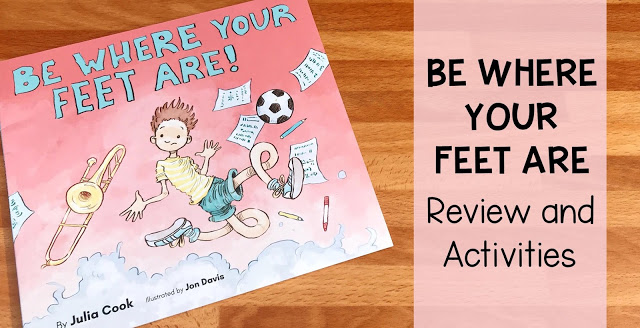
While reading this book, I could almost feel myself cringing because it was essentially describing my own jumping thoughts and multitasking ways. Be Where Your Feet Are (affiliate link) is about a boy whose mind hops around from idea to idea…and he struggles because of it (failed math test, awful soccer game, frustrated mom, etc.). It also speaks to the fact that our kiddos often have a lot on their plates.

The story, in true Julia Cook fashion, involves the boy’s mom teaching him the lesson – in this case: BE WHERE YOUR FEET ARE. I have to admit that I had never heard this phrase until this book was announced and I really love it. His mom points out that the most successful part of the day was the part when he was totally present. The boy takes her advice and, of course, he has a better next day.

One wonderful thing about this book is that it is simple and kid-friendly in its depiction of mindfulness. The vocabulary feels accessible and while the story is 31 pages long, it didn’t feel overly wordy. I also loved that it talked explicitly about multi-tasking as well. The book feels like a great fit for 2nd-5th grade students and could be used in small groups or for whole group lessons. I’m also envisioning this as a great early year read for counselors who plan to start the rest of their lessons with mindful moments. Side note: My mother in law was in town when I received these and she picked one up to read and commented on how much she too liked the message.
Mindfulness is tricky – and so I think reading the book is an awesome starting point (or reinforcement if you’ve already begun discussing this topic) but that kiddos need more discussion and practices to really “get it.” I created some resources that partner with this to use in lessons in order to help students better understand how to be mindful.
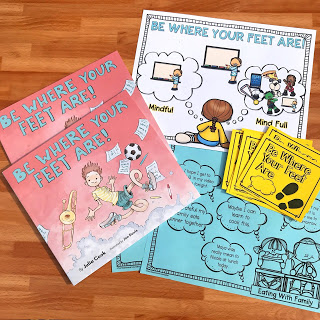 One activity I’m going to use will have students physically feel the difference between focusing on one thing vs. multitasking or thinking about many different things. You can do this by taping different colored pieces of paper spread out on the floor or by using pages that have different graphics on them. Ask students to literally “jump” from topic to topic, thought to thought. Then tape or layout pages with the same graphic on them (or same colored paper) and ask students to walk along the straight path to illustrate how much easier it is to stay on the same idea.
 It’s also helpful for students to see and practice with additional examples and situations. The resource I made includes sheets showing different scenarios and thoughts that can occur with them. Students identify (individually, in small groups, or whole group) which thoughts show the character being where their feet are. I also made some task cards to use with my students to help them 1) practice using strategies to help them be more mindful and 2) discuss the concept in some more depth. You can find the activities in my store by clicking the picture to the left.
And as an aside, the National Center for Youth Issues rocks. They publish SO many of the books (bibliotherapy and resources) that we love as school counselors. I’m also a big fan because they host/sponsor some state school counseling conferences (including one I’ve presented at for a few years now). You can look up their conferences and resources here: https://ncyi.org/
Disclosures: I received free copies of this book in exchange for an honest review. All of my views are my own. I’ll only ever review and share books that I think are great and that I do or would use with my own students. You must 18 years old and a resident of the United States to enter. Giveaway ends at 12am CST Wednesday, August 1st. This giveaway is now closed.
Julia Cook’s Be Where Your Feet Are is a wonderful story for teaching students about the importance of being present. This set of companion activities is great for students to continue understanding this concept, practicing how to be present, and becoming more self-aware of their own mindfulness (or mind full-ness!). There are a wide variety of activities included allowing you to pick what’s best for your group(s) or for extending the lesson over multiple days. This resource was created to be used by school counselors or classroom teachers.