Using an Emotional Behavioral Universal Screener
Learn how one school counselor used an emotional behavioral universal screener (the SRSS-IE) to identify students at risk for internalizing and externalizing concerns and guide group counseling and CICO referrals.

Key Takeaways
- Universal screeners give schools a data-based starting point for behavior and emotional supports.
- The SRSS-IE is free and fast for teachers to complete.
- Screener data can help flag students with internalizing concerns who might go unnoticed.
- Screeners show risk level, so you'll still need more information to choose interventions.
Several years ago, school districts across the country adopted Response to Intervention (RTI) protocols for academics. Now schools are working to develop RTI-B; a systematic tiered approach to student behavior problems. One component of this that many schools are incorporating is a universal screener (just like is used with academics!) for emotional/behavioral concerns.

I was at one of 15ish schools in my district that piloted the use of the Student Risk Screener Survey for Internalizing and Externalizing behaviors, better known as the SRSS-IE. It has been validated over numerous studies – you can find some of the articles mentioned on this site about tiered intervention models. A google search will give you loads of information about the SRSS-IE, including the actual measure itself. This post serves to give a brief rundown and to share my experience using it as a school counselor.
The SRSS-IE looks at the following specific behaviors:
- Steal
- Lie, cheat, sneak
- Behavior problem
- Peer rejection
- Low academic achievement
- Negative attitude
- Aggressive behavior
- Emotionally flat
- Shy, withdrawn
- Sad, depressed
- Anxious
- Lonely
How does a universal screener work?
Teachers rate each student on how frequently they display these behaviors on a likert-type scale of never, occasionally, sometimes, or frequently. Each teachers has one spreadsheet for their homeroom that scores are entered into, which takes about 20-30 minutes per class.
Counselors (and other faculty in charge of RTI-B) gathered together in August to be trained in the screener. Just like our academic universal screener, we ‘administer’ it three times a year (early September, mid December or mid January, and mid May). The first time we did it, I met with each grade level team to explain it’s purpose and how to complete it. I was surprised to get some push back from a couple teachers that were really worried about scoring their students in this way, and concerned about kiddos being labeled. A couple remained hesitant even in our second administration, but still completed it (because I was a little insistent and I believe they trusted me to use the data appropriately).
The second school that I rolled this out with, I created some super quick slides to explain some things to teachers. Click the image below if they’d be helpful to you – free download from Dropbox! (Just make sure to download and open in PowerPoint – it’ll look a little wonky in Dropbox)

Per our training, I was not able to provide definitions or clarification about the constructs on the screener. That was really hard for all of us, but our trainers promised it was validated without providing operational definitions so I kept my lips zipped and asked my teachers to just score however their brains worked.

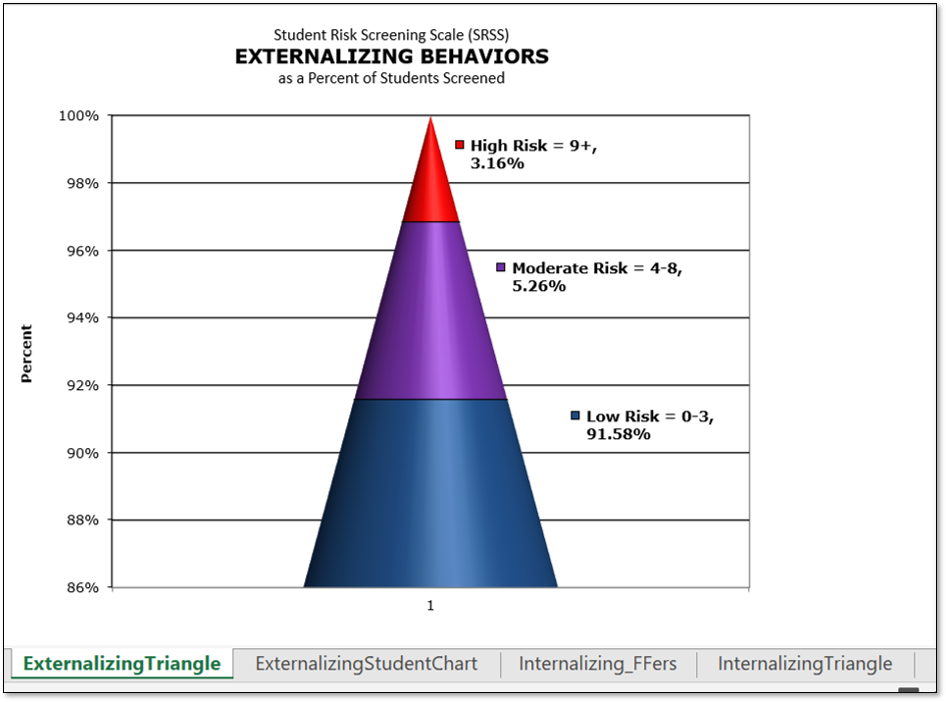
When they finished, teachers emailed me their spreadsheets and I compiled the data into a mega spreadsheet for each grade level (and then later for the whole school). These spreadsheets also had some fancy data analysis bits worked in and provided me with an RTI triangle breaking down the percentage of students in each risk tier (for externalizing and internalizing separately) as well as a list of students from highest to lowest scores. (Don’t be fooled by the example below – it’s just an example, not my school! I couldn’t figure out how to adjust the y-axis, but I prefer a 0-100% view instead of zoomed in on the 85-100% range.)
What did I do with the data?
I personally wanted the data primarily to help guide small group counseling referrals. It was easy for me to see a list of students that needed extra support with internalizing emotions and a list of students that needed extra support with their behavior. These names were a great start to developing group rosters. It also gave me data to make informed decisions about which students to prioritize for our Check In Check Out intervention. And seeing the risk level breakdown for each grade level helped me see which teaching teams needed more support with tier 1 supports (like PBIS, morning meetings, and counseling lessons).
While small group counseling and CICO are the primary tiered interventions put into place, I continue to learn more and more about reasons students misbehave and how we can help them. This behavior intervention guide is a great starting place if you’re discussing specific students or just want to learn more about consulting with teachers around behavior intervention.
The Highs
- It’s free!
- It’s fast! This is huge for me because my teachers are always stressed with mega tight schedules.
- Working with the data is pretty simple and user-friendly.
- Having a data-based starting point for developing social/emotional/behavioral interventions is AWESOME.
- Some of my internalizing students that would have otherwise gone under the radar were flagged for support.
The Lows
- It gives risk level, it does not provide information about lagging skills to be taught or what type(s) of intervention would be the best fit.
- Some of the items on the measure seem to overly identify ELL students, such as “low academic achievement” (thankfully, most of my teachers answered this for them in comparison to ELL peers) and “shy, withdrawn.”
- It can easily miss students who need social skills support. I often have kiddos that don’t break rules or appear anxious/depressed but still need help developing more positive peer relationships.
There are other social/emotional/behavioral screeners, such as SAEBRS, the SDQ, the BASC, and DESSA. From what I’ve seen, they provide significantly more information about students that would help in intervention planning. That said, they are not all free and they all take significantly more time (the DESSA-mini being the next shortest). My district only supports us using the SRSS-IE so I’m sticking with that, but I hope I’ll have the opportunity to try out another one in the future. If you’re using an emotional/behavioral universal screener, I would love to hear about your experiences!